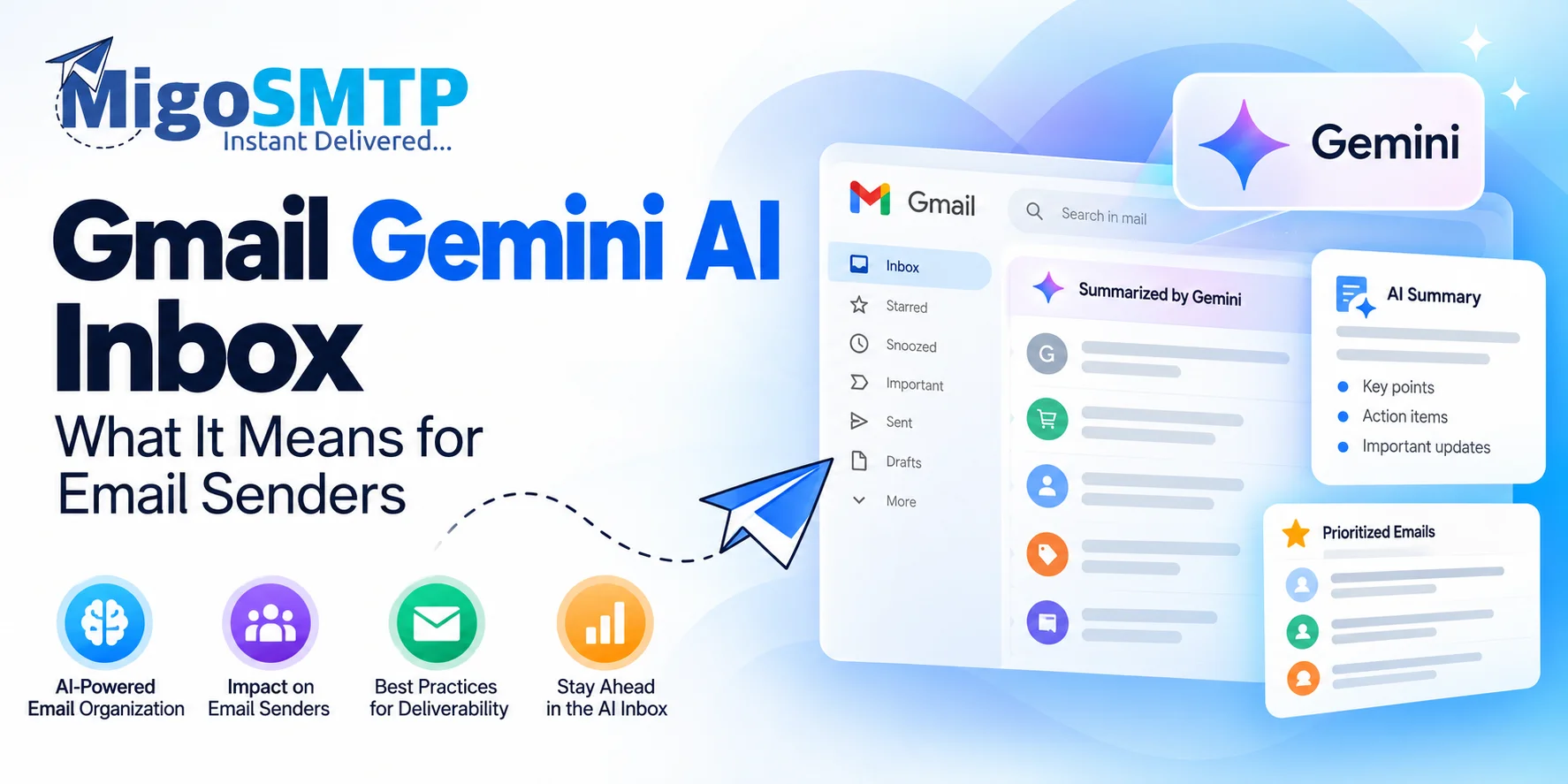
Gmail's Gemini features are the biggest change to how people read email since the inbox tab system arrived. On 8 January 2026, Google announced that Gmail was "entering the Gemini era", with AI thread summaries, natural-language questions about your inbox, smarter reply suggestions and a prioritised view called AI Inbox. For anyone who sends email at scale, the question is not whether this is clever. It is what happens to a message when the first reader is a model and the human only sees a summary.
This article separates what Google has actually announced from what the industry is guessing, looks at the numbers that frame the stakes, and sets out three scenarios for the next two years. Where a figure comes from a vendor rather than from Google, we say so.
What Google actually announced
Google's announcement lists a small set of features, and the details of who gets which feature matter for senders. According to the Gmail announcement on the Google blog:
- AI Overviews on conversations summarise long threads, and were rolling out at no cost to everyone from 8 January 2026.
- AI Overviews on the inbox let a user ask questions in natural language about their mail. This is for Google AI Pro and Ultra subscribers.
- Help Me Write and Suggested Replies draft and polish messages and offer one-click, context-aware answers, free for everyone.
- Proofread checks grammar, tone and style, for AI Pro and Ultra subscribers.
- AI Inbox filters lower-priority messages and surfaces to-dos. At the time of the announcement it was limited to trusted testers, with wider availability promised "in the coming months".
Launch coverage described the features as English-only and U.S.-first, with more languages and regions to follow (Tom's Guide, 8 January 2026). That matters for timing: a sender with a mostly non-U.S. audience will feel this later than one with a U.S. audience, but the direction is set.
What is still unknown
Much of the commentary since January treats AI Inbox as a new filter that will bury promotional mail. The primary sources do not say that. A careful analysis by Folderly notes that Gemini changes how recipients review mail, not how senders are evaluated, and reports that AI Inbox draws on the Primary tab and excludes Social and Promotions, spam, and messages a user has archived, muted or snoozed. The same article observes that Google's own sender guidance says it does not track open rates, so any platform number should not be mistaken for confirmed Gmail data.
So the honest position in late 2026 is this: the summarisation layer is real and free to every Gmail user, the prioritisation layer is staged and narrower, and nobody outside Google can yet publish clean data on how either changes engagement. Anyone quoting a precise "AI Inbox lifts or cuts click rate by X%" figure is extrapolating.
Why the stakes are large
Two numbers explain why even a small shift in reading behaviour matters. First, scale. The Radicati Group's Email Statistics Report 2024 to 2028 estimates 4,481 million email users worldwide in 2024, growing to 4,970 million by 2028, and 361.6 billion emails sent and received per day in 2024, rising to 424.2 billion in 2028. Volume grows around 4% a year, which means the inbox gets more crowded every year, and summarisation is a rational response from the platform.
Second, concentration. In Litmus's July 2026 client data, built from more than a billion opens, Apple accounts for 62.26% of tracked opens and Gmail for 27.03% (Litmus email client market share). Litmus notes that Apple's figure includes opens produced by Mail Privacy Protection, and that image blocking can distort every client's share, so treat these as an indicator of where measured activity happens rather than a census of people. Even so, the picture is clear: two companies sit between most senders and most readers, and both are adding AI to the reading experience.
How a summary changes the job of an email
A thread summary is not a spam filter. It does not decide whether your message arrives. It decides what a busy reader believes the message said, which is a different problem, and it has three practical consequences.
1. The first screen is now machine-readable copy
When a model condenses a message, the content that survives is the content that is stated plainly: the offer, the deadline, the action, the amount. Decorative preheaders, teaser subject lines and "see below" structures lose value because there is nothing for a summary to carry. This favours messages that put the point first, which is also what accessibility guidance has recommended for years.
2. Transactional and conversational mail gains weight
Thread summaries work best on conversations, so receipts, security notices, shipping updates, booking confirmations and support replies are the messages most likely to be read through an AI layer. These are the same messages that depend on reliable delivery, which keeps authentication and sender reputation as the foundation. A beautiful summary of a message that never arrived helps nobody.
3. Click and open metrics become even less trustworthy
If a model reads the message for the recipient, a human may act on the summary without ever loading the email body. Opens, already unreliable, will say even less. The sensible response is to measure outcomes further down the funnel: replies, purchases, sign-ins, account activations. We cover this in more detail in our analysis of why the open rate is ending as a metric.
Three scenarios for 2027 and 2028
Nobody can forecast this precisely, so it is more useful to plan against scenarios than against one prediction.
| Scenario | What happens | Who benefits | What senders should do |
|---|---|---|---|
| Summaries only | AI stays an optional reading aid. Delivery rules stay the same. | Clear, honest senders | Write plainly, state the action early, keep measuring outcomes |
| Prioritisation widens | AI Inbox reaches more users and languages and starts to rank mail by perceived importance. | Senders with strong engagement and consistent identity | Protect reputation, prune inactive recipients, send fewer and better messages |
| Agents act on mail | Assistants unsubscribe, reply, pay and book on the user's behalf. | Senders whose messages are structured and verifiable | Use structured data, clear unsubscribe headers and authenticated identity |
The third scenario is the speculative one, and we flag it as such. But the building blocks exist already: a one-click unsubscribe header that software can act on, authenticated sender identity through SPF, DKIM and DMARC, and brand logos verified through BIMI. These are the signals an automated reader can trust. A sender that has them in place loses nothing if the first scenario holds, and gains if the third arrives.
What to do now
None of this requires a new tool. It requires finishing the basics and changing a few habits.
- Get the fundamentals right. Authenticate with SPF, DKIM and DMARC, keep complaint rates low and watch your reputation in Google Postmaster Tools. Folderly's advice is to keep monitoring these under Gmail's published guidance rather than chase an AI-specific ranking trick, and we agree.
- Write for a reader and a summariser. Use an accurate subject line, state the main point in the first sentence, label deadlines and prices, and make the next step easy to find. These are editorial practices to test with your own audience, not a known ranking formula.
- Do not credit Gemini for metric changes without a control. Compare cohorts with the same audience, period and tracking method before concluding anything. Seed-list placement tests show what happened in a test inbox, not how Gemini treats a particular recipient.
- Separate three questions. Did the message reach the server (SMTP result)? Where did it land (folder placement)? Did the person pay attention (outcome)? They are different observations and need different tools.
- Prepare for machine readers. Keep your unsubscribe header correct, keep sender identity consistent and consider structured, plain-text-friendly layouts.
A fair reading of the evidence. As of October 2026, Google has confirmed summarisation and drafting features and a staged AI Inbox. It has not published data showing that any of them demotes bulk mail, and independent analysis stresses the same limit. Plan for change, but do not rebuild your programme around a rumour.
The bigger picture
Email has survived every predicted replacement because it is open, federated and tied to identity. AI does not change those properties; it adds a reading layer on top. The senders most exposed are the ones who relied on attention tricks, because a summary strips tricks away. The senders best placed are the ones whose mail is authenticated, expected and useful, because a summary of useful mail is still useful.
The strategic shift is from optimising for the click to optimising for the outcome the message is meant to produce. That is harder to measure and easier to defend. It also happens to be the same advice the deliverability rules of the past three years have been pushing, which we cover in our analysis of bulk-sender enforcement.
Want to check your authentication before the next wave of changes? Start with our troubleshooting checklist, or talk to us about your sending setup.
Sources
Frequently asked questions
Does Gmail's AI Inbox send promotional email to spam?
Google has not said so. AI Inbox is a separate prioritised view, and one analysis reports that it draws on the Primary tab and excludes Social and Promotions. It does not change whether a message is delivered.
Are Gmail's Gemini features available to everyone?
Thread summaries, Help Me Write and Suggested Replies began rolling out free to all users in the US from 8 January 2026. Inbox questions and Proofread need Google AI Pro or Ultra, and AI Inbox was limited to trusted testers at launch.
Should I change my subject lines because of Gemini?
Write clearly and state the main point early, which is good practice anyway, but test changes against a control group. Nobody has published evidence that a specific subject-line style ranks better in AI summaries.
How do I measure the effect of Gemini on my campaigns?
Compare cohorts with the same audience, period and tracking method, and measure outcomes such as replies, sign-ins and purchases rather than opens. Seed-list tests show test-inbox behaviour, not how Gemini treats a recipient.